"Ringbow" is a recent, half-funded Kickstarter project from a team that
includes Andrew Hartman, design director of Philips Electronics. It's a
Bluetooth game-controller that you wear on your finger, serving as "a
mouse, keyboard and joystick simultaneously." A $35 pledge gets you one
when they ship.
Showing posts with label Science. Show all posts
Showing posts with label Science. Show all posts
Thursday, 28 June 2012
Tuesday, 15 May 2012
Geoengineering and the Fight against Climate Change: Maggie on "To the Point" radio show (audio)

Two of my favorite people talk about one of my favorite topics, all on the same radio program. Our very own Maggie Koerth-Baker was interviewed by my friend (and former NPR colleague) Alex Chadwick on KCRW's daily show "To the Point" today, to talk about "Geoengineering and the fight against climate change."
Human "Ingredients-List" shirt

Qwantz sends us "A shirt (done in consultation with medical professionals) that not only lists your nutritional
Can a kid be a psychopath?
The New York Times has a fascinating (and, FYI, kind of disturbing)
story about young kids who exhibit psychological symptoms similar to
what you see in adult psychopaths. It's a complex subject because, while
everybody involved agrees these kids could use some kind of
intervention, nobody knows exactly what that intervention should be and
definitely don't want to stick the kids with a terrifying label that
will follow them for their whole lives. More importantly, what we do know is that half of these kids will grow into normal adults—though we don't know exactly why.
Volcano in a trash can
Watch video
Plinian eruptions are named after Pliny the Younger and Pliny the Elder, who wrote about the eruption of Mount Vesuvius in AD 79 and died during said eruption, respectively. This is one of several different types of volcanic eruptions, but it's also one of the most iconic. In a Plinian eruption, a column of magma, gas, and ash shoots straight up, with the gas and ash reaching all the way up into the stratosphere. These are the big, explosive eruptions, with mushroom clouds and rains of rocks and boulders.
Plinian eruptions are named after Pliny the Younger and Pliny the Elder, who wrote about the eruption of Mount Vesuvius in AD 79 and died during said eruption, respectively. This is one of several different types of volcanic eruptions, but it's also one of the most iconic. In a Plinian eruption, a column of magma, gas, and ash shoots straight up, with the gas and ash reaching all the way up into the stratosphere. These are the big, explosive eruptions, with mushroom clouds and rains of rocks and boulders.
How to: Make a unicorn

At Popperfont, the great David Ng discusses the biological and/or evolutionary steps necessary to produce a theoretical real-life unicorn. I find it delightfully ironic that his first possible route involves something that, if I were to show you pictures of it*, you would probably request a unicorn chaser.

High-tech ghost-town being built in the middle of the NM desert
A defense contractor called Pegasus Global Holdings
is building a replica of Rock Hill, SC in the middle of the New Mexico
desert, which will be used to prototype self-driving cars, green
buildings and smart meters. It will be an uninhabited lab, a "theme park
for scientists." They're calling it "The Center for Innovation, Testing
and Evaluation." From Don Worthington's article in the Rock Hill Herald:
Monday, 14 May 2012
Looting Leads Archaeologists to Oldest Known Mayan Calendar
On 21 July 1561, a crowd of indigenous farmers cried out in the town
square of Maní, Mexico, as a Franciscan missionary set fire to dozens
of fragile Maya
books, or codices. Condemned by the missionaries as "the Devil's
trickery," these written texts preserved knowledge gleaned from
centuries of Maya science
and mathematics. Similar acts of destruction followed, obliterating
hundreds of other Maya codices. Today, only a handful of readable,
precolonial codices
survive.
Vesta, the planet that might have been
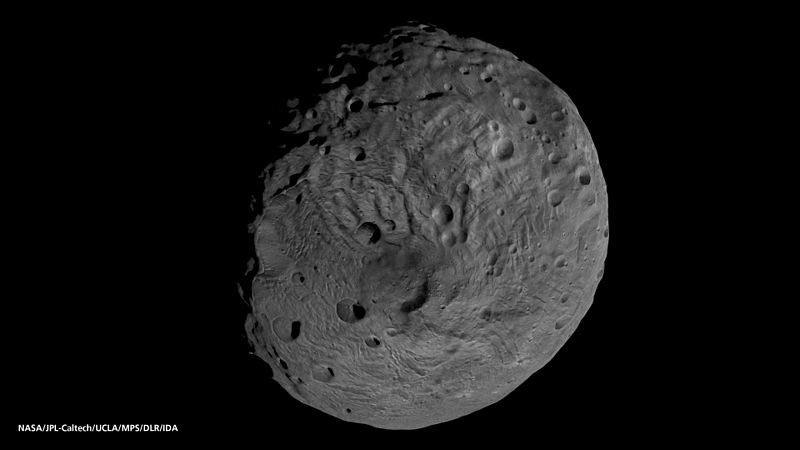
This is Vesta, the second largest asteroid in our solar system's main asteroid belt. Specifically, this is a view of Vesta's south pole, taken by NASA's Dawn spacecraft last September.
Curiosity in the desert
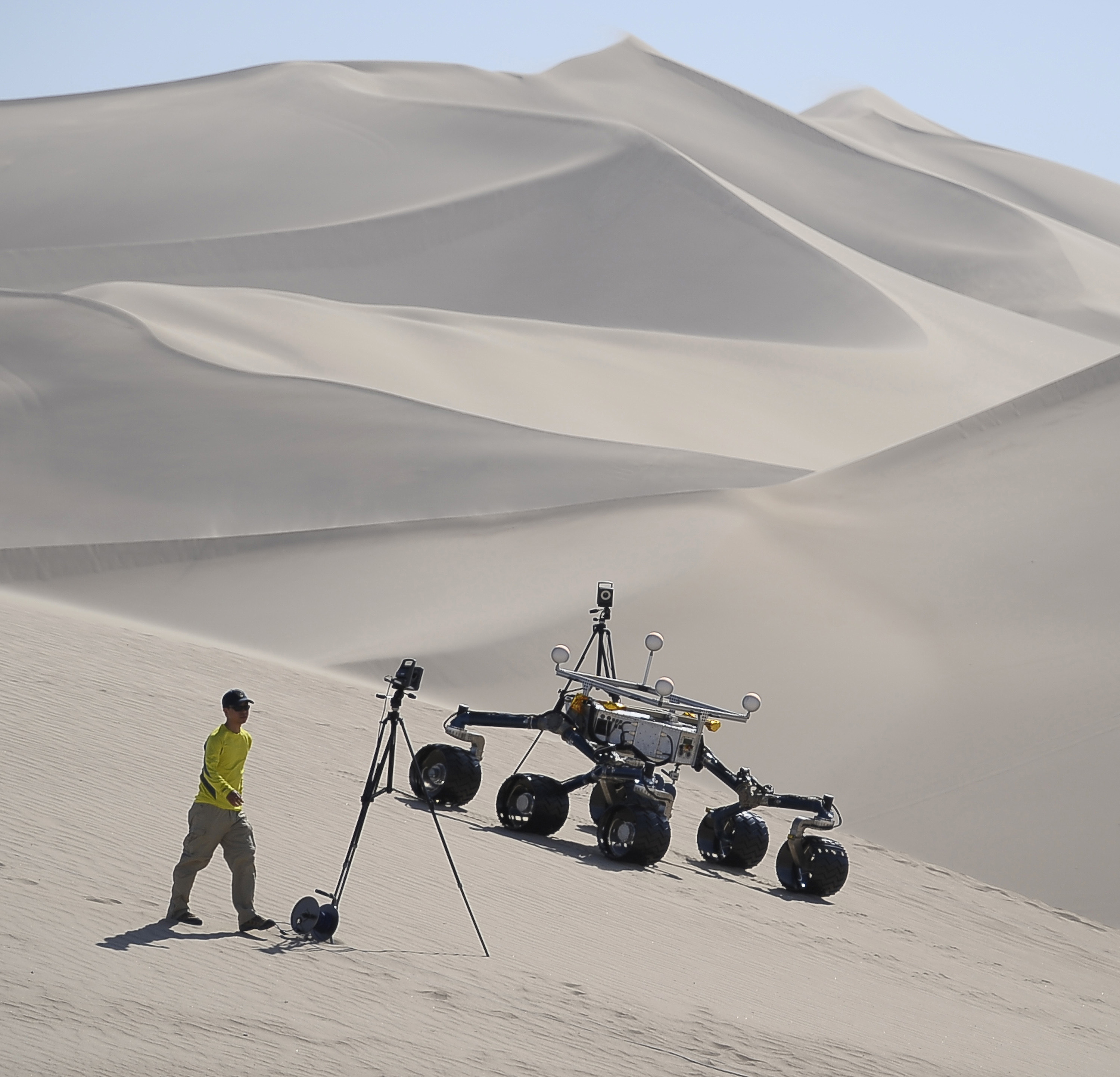
Last week, scientists used ice caves in Austria as a stand-in for Martian caves, testing spacesuits and rovers in the freezing chambers. This week: We go to the desert near Baker, California, where NASA is testing out its Curiosity rover. Curiosity is 86 days away from landing on the real Martian surface.
Gene Blevins / Reuters
Sunday, 13 May 2012
Newly-discovered Mayan calendar in Guatemala proves (again) the world won't end in 2012
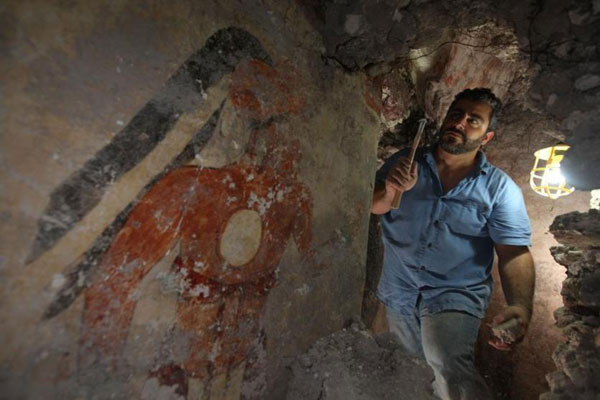
An archaeological expedition in the northeastern lowlands of Guatemala yields an amazing discovery: the "9th-century workplace of a city scribe, an unusual dwelling adorned with magnificent pictures of the king and other royals and the oldest known Maya calendar."
From Thomas Maugh's report in the Los Angeles Times, on the dig in the ruins of Xultun led by William Saturno of Boston University:
Jack Williamson on what the future meant in the era of scientifiction
Here's science fiction grand master Jack Williamson ruminating on what
the future once meant, when he started working in the field, including a
reading of an early essay on the future he wrote in the 1920s or 1930s:
Wednesday, 9 May 2012
Space Tugboat Could Help Move Inexpensive Payloads in Orbit

A Seattle company has announced plans to build a new spacecraft that, like its Earth-bound counterparts, is all about moving other vehicles around. Spaceflight Inc. is designing what it’s calling the Sherpa to fulfill the need for an orbital tugboat that can move payloads, such as satellites, to different orbits around Earth.
Navy Wants Ultra-Violet Cloaking Device for Jet Fighters

The U.S. military is already investing tens of billions of dollars to make its jet fighters less visible to radars and infrared sensors. Now the Pentagon wants the defense industry to come up with a system that can cloak fighters from another telltale type of radiation: ultra-violet energy from the sun.
Tuesday, 8 May 2012
<script type="text/javascript">
var _gaq = _gaq || [];
_gaq.push(['_setAccount', 'UA-31515977-1']);
_gaq.push(['_trackPageview']);
(function() {
var ga = document.createElement('script'); ga.type = 'text/javascript'; ga.async = true;
ga.src = ('https:' == document.location.protocol ? 'https://ssl' : 'http://www') + '.google-analytics.com/ga.js';
var s = document.getElementsByTagName('script')[0]; s.parentNode.insertBefore(ga, s);
})();
</script>
var _gaq = _gaq || [];
_gaq.push(['_setAccount', 'UA-31515977-1']);
_gaq.push(['_trackPageview']);
(function() {
var ga = document.createElement('script'); ga.type = 'text/javascript'; ga.async = true;
ga.src = ('https:' == document.location.protocol ? 'https://ssl' : 'http://www') + '.google-analytics.com/ga.js';
var s = document.getElementsByTagName('script')[0]; s.parentNode.insertBefore(ga, s);
})();
</script>
Giant panda insemination more fascinating than you might guess

Earlier this week, the Smithsonian National Zoo live-tweeted their most recent attempt to knock up a giant panda. You can read the whole thing at Storify. And, seriously people, you should read it. I originally intended to just post a short link to this, almost as a joke, but it turns out that the process of inseminating a giant panda is actually really interesting.
Tips and tricks for being a better scientist
Astrobetter: It's like Lifehacker, but for astronomers. Although,
frankly, I think a lot of the tips and tricks would apply just as well
to other branches of science. Learn how to talk about your research
without rambling. Add QR codes to your posters. Improve your peer
reviewing skills. (Via a really neat conversation about science communication tools happening now at Science Online New York City. #sonyc) — Maggie
How To: Assemble a large hadron collider
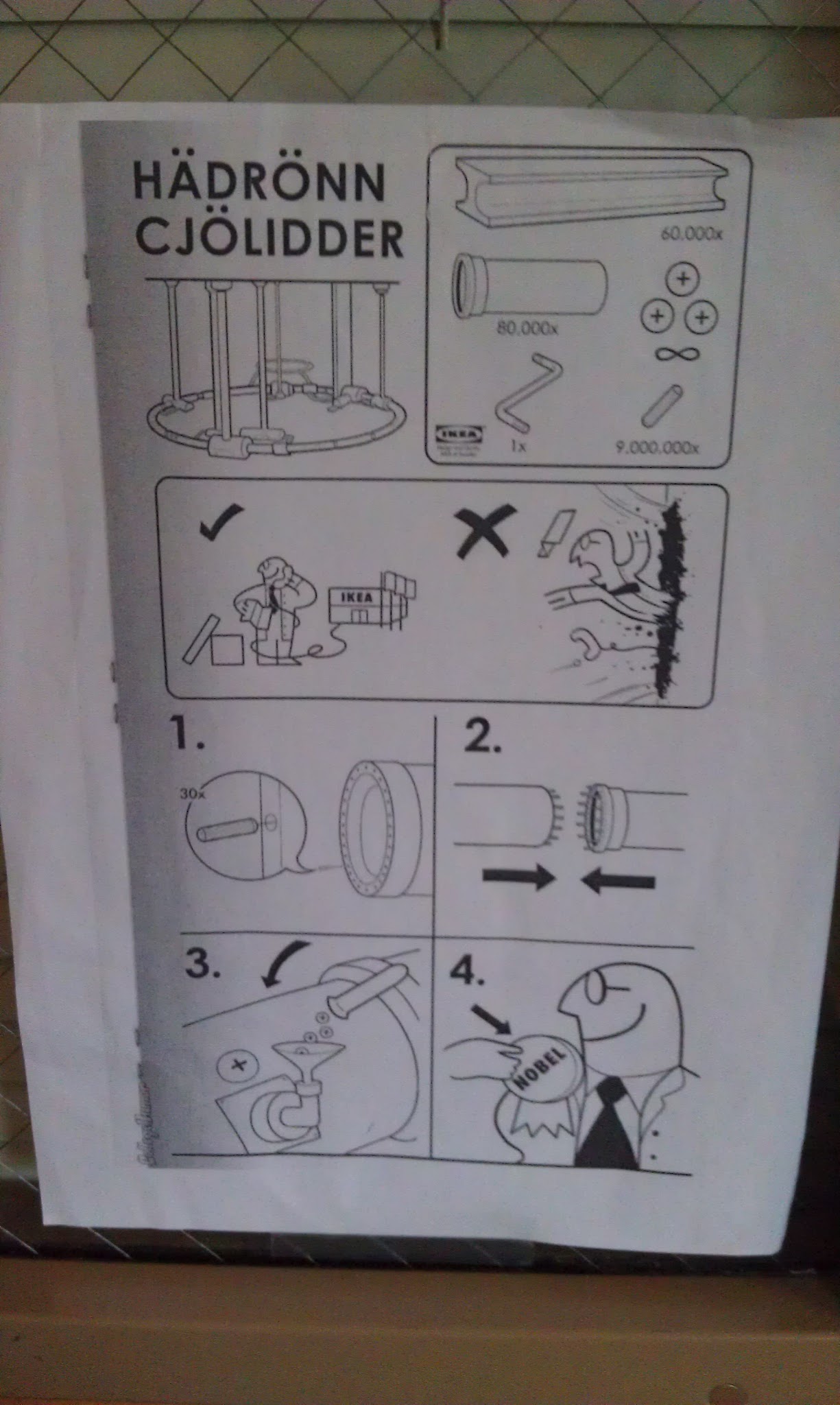
One of my favorite parts about going on tours of laboratories are the signs and jokes that scientists post on office doors and lab walls. This gem comes from the Lawrence Berkeley National Laboratory.
The obvious question: How do you transport an infinite number of protons home from IKEA? Does that fit on the little cardboard roof rack?
The diversity of particle accelerators
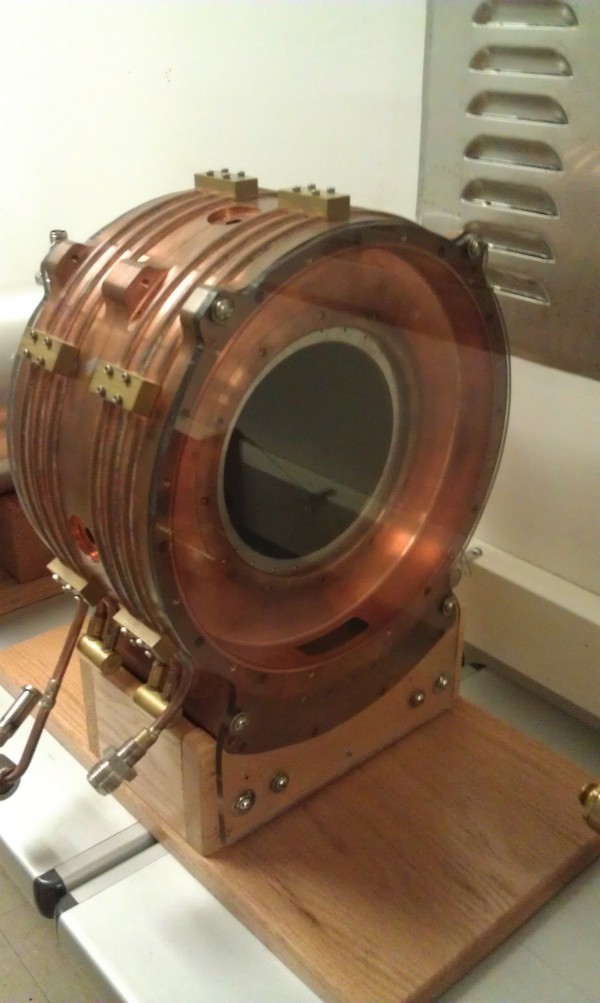
Today, I got to tour several particle accelerator research labs at the Lawrence Berkeley National Laboratory, including an inside look at a working accelerator, something I'd never seen up close before. Suffice to say, it was awesome, and I will be posting more on that here after I'm able to do a few more interviews.
Kinetic, electrified junkbots from Nemo Gould
Kinetic junkbot sculptor Nemo Gould has completed two new, wonderful pieces. First, the Cycloptopus:
Cycloptopus is a fearsome hybrid of two of my favorite monsters, one real, one mythical. This creature is particularly dangerous because of its irritability. You’d be irritable too if you were powered by an open flame and your body was made of wood.
Materials: Radio cabinets, rocking chairs, fake fireplace, decorative clock elements, cabinet knobs, wall paper, chair parts, lamp parts, wheel hub, motors, LEDs
Subscribe to:
Posts (Atom)