Wednesday, 16 May 2012

“Shrapnel Biddulph” – telegraph engineer, soldier, romantic and artist

Captain Michael Anthony Shrapnel Biddulph was posted to Turkey in 1854, and shortly afterwards to the Crimea, where he served with distinction as assistant engineer of the Royal Artillery, and later as director of submarine telegraphs in the Black Sea. Decorated by the French and Turkish governments, in 1856 he was promoted Brevet Lieutenant Colonel. In 1858 he was appointed Chief Engineer of the Ottoman Telegraph, overseeing the construction of telegraph cable lines in Turkey-in-Asia.

 G70066-71a for blog
Vignette (1)

Vignettes taken from Plan of a Portion of the Constantinople and Bussorah [Basra] Line of Telegraph. War Office, 1860. Maps R.U.S.I. A20.4.

Benevolence from Bengal: Amir Chand’s bequest

The mercantile classes have long been associated with acts of charity within the communities in which they live and the records of the East India Company provide ample evidence of numerous philanthropic deeds. One notable example is a bequest left by one of India’s most famous eighteenth century merchants Amir Chand [Omichund, Umichund].
Foundling Hospital G70037-05 for blog
A major trader with the Nawabs of Bengal and the East India Company, Amir Chand is best remembered

Sir Josiah’s Disobedient Child

Sir Josiah Child (bap.1631, d.1699) was the successful son of a London merchant. He made a large fortune as a brewer and victualler and through the Royal African and East India Companies. Child bought an estate at Wanstead in Essex and lavished money on landscaping. Palladian Wanstead House pictured below was built after Sir Josiah’s death by his son Richard.
Wanstead for blog
View of Wanstead House, by G. Robertson; engraved by Fittler
BL: Maps.K.Top.13.30.d © The British Library Board Images Online

Child was active in local politics, sat as an MP, and served nearly 25 years as an East India Company director, with two periods as Governor. He was the author of a number of economic tracts, and his letters and published works can be read today in the British Library. He married three times and had eight children.

Family budgets in 1920s India

The Royal Commission on the Superior Civil Services in India (the Lee Commission) was appointed in 1923 to enquire into the organisation and general conditions of service, the possibility of transferring any duties and functions to provincial services, and the recruitment of Europeans and Indians.
To assist in its enquiry into the conditions of service the Royal Commission collected examples of the budgets of individual members of the civil service, some very detailed. The general thrust of the evidence submitted was the rising cost of living in India and the inadequate pay of civil servants.
IOR Q Bazaar prices for blogOne example is a budget submitted with the written evidence of the Indian Educational Association, Burma (IOR/Q/11/24 No.1002). It compares the Bazaar prices of various goods in 1913/14 and 1923, such as foodstuffs, furniture, crockery and clothes, and lists the cost of the various types of servants (head boy, ayah, cook, paniwallah, sweeper, chauffeur, dhobi, mali, etc).
The anonymous monthly budget of a Professor in the University of Rangoon in his first year of service gives an interesting insight in to what civil servants felt they had to spend to keep up what they saw as their status in the community in which they lived and worked, both in the eyes of other Europeans and of native Indians. The Professor had four servants (personal boy, driver, sweeper and dhobi), employed a typist, owned a car, subscribed to a large number of scientific societies and was a member of three clubs (Golf Club, Gymkhana Club and Boat Club). His wife suffered a break down in her health after only a short time in Burma and had to return to England, and he lists the expenses associated with doctors' bills and her return passage. In fact expenses associated with medical problems were a

The search for Black Rock Part II

Here is the second part of our story from the Andaman Islands contributed by guest blogger N. Francis Xavier.
Giant trees rose on either side of the narrow trail as it snaked through the tropical forest forming a thick canopy overhead. Huge lianas hung down from their branches like pythons.  The trail seemed endless as it dipped and rose and again dipped into the evergreen forest.

Tuesday, 15 May 2012

Geoengineering and the Fight against Climate Change: Maggie on "To the Point" radio show (audio)


Two of my favorite people talk about one of my favorite topics, all on the same radio program. Our very own Maggie Koerth-Baker was interviewed by my friend (and former NPR colleague) Alex Chadwick on KCRW's daily show "To the Point" today, to talk about "Geoengineering and the fight against climate change."

Human "Ingredients-List" shirt


Qwantz sends us "A shirt (done in consultation with medical professionals) that not only lists your nutritional

Can a kid be a psychopath?

The New York Times has a fascinating (and, FYI, kind of disturbing) story about young kids who exhibit psychological symptoms similar to what you see in adult psychopaths. It's a complex subject because, while everybody involved agrees these kids could use some kind of intervention, nobody knows exactly what that intervention should be and definitely don't want to stick the kids with a terrifying label that will follow them for their whole lives. More importantly, what we do know is that half of these kids will grow into normal adults—though we don't know exactly why.

Volcano in a trash can

Watch video 

Plinian eruptions are named after Pliny the Younger and Pliny the Elder, who wrote about the eruption of Mount Vesuvius in AD 79 and died during said eruption, respectively. This is one of several different types of volcanic eruptions, but it's also one of the most iconic. In a Plinian eruption, a column of magma, gas, and ash shoots straight up, with the gas and ash reaching all the way up into the stratosphere. These are the big, explosive eruptions, with mushroom clouds and rains of rocks and boulders.

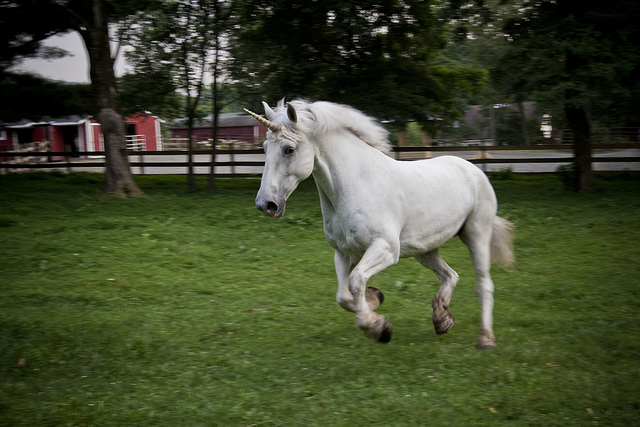
How to: Make a unicorn


At Popperfont, the great David Ng discusses the biological and/or evolutionary steps necessary to produce a theoretical real-life unicorn. I find it delightfully ironic that his first possible route involves something that, if I were to show you pictures of it*, you would probably request a unicorn chaser.